
Volkswagen Polo Owners Manual: Locking and unlocking the vehicle from the outside
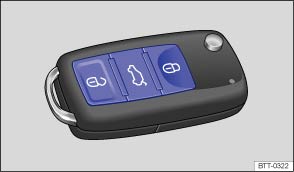
Fig. 23 Buttons on the vehicle key
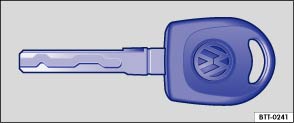
Fig. 24 Mechanical vehicle key
 First read and observe the introductory information
and safety warnings
First read and observe the introductory information
and safety warnings
| Function | Buttons to be used in the vehicle key | Action to be followed with key in the lock cylinder or |
|---|---|---|
| Unlocking the vehicle. | Press the  button.
Press and hold for convenience opening. button.
Press and hold for convenience opening. |
Insert the vehicle key in the driver door lock cylinder and turn anticlockwise. Turn and hold for convenience opening. |
| Locking the vehicle. | Press the  button.
Press and hold for convenience closing. In vehicles with a SAFELOCK mechanism,
press the button once
to lock the vehicle using the SAFELOCK mechanism . Press the
button twice to lock
the vehicle without the SAFELOCK mechanism. button.
Press and hold for convenience closing. In vehicles with a SAFELOCK mechanism,
press the button once
to lock the vehicle using the SAFELOCK mechanism . Press the
button twice to lock
the vehicle without the SAFELOCK mechanism. |
Insert the vehicle key in the driver door lock cylinder and turn clockwise. Turn and hold for convenience closing. |
| Unlocking the tailgate. | Press the  button
. button
. |
Insert the vehicle key in the driver door lock cylinder and turn anticlockwise. |
Please note: depending on the settings made for the central
locking system, all of the doors and the tailgate may only be unlocked once the
button has been pressed twice.
A qualified workshop may be able to program and modify other functions depending on the vehicle equipment level. Volkswagen recommends using a Volkswagen dealership for this purpose.
The vehicle key will lock or unlock the vehicle only when the battery has enough power and the key is located within a few metres of the vehicle.
- When the vehicle is locked, all turn signals will flash once as confirmation.
- When the vehicle is unlocked, all turn signals will flash twice as confirmation.
If the turn signals do not flash as confirmation, at least one of the doors or the tailgate is not closed.
The vehicle cannot be locked using the vehicle key if the driver door is still open. The vehicle will lock again automatically within a few seconds of being unlocked if you do not open one of the doors or the tailgate. This function prevents the vehicle from remaining unlocked if the unlocking button is pressed by mistake.
Convenience opening and closing
- See electric windows – functions .
- See Electric panorama sliding/tilting glass roof – functions .
 Description of the central locking system
First read and observe the introductory information
and safety warnings
The central locking system enables you to lock and unlock all the doors, the
tailgate and tank flap from one central point: ...
 Locking and unlocking the vehicle from the inside
Fig. 25 In the driver door: central locking
button
First read and observe the introductory information
and safety warnings
Press the button :
Unlock ...
Other materials:
Reinforced Shock Absorbers and Coil Springs
Reinforced shock absorbers and coil springs on the vehicle
rear axle reduce pitching motions between the vehicle and the
trailer. If not already installed in the factory, these shock
absorbers and springs can often be retrofitted at authorized
Volk ...
Two-Part HS Top Coat
Definition:
Two-Part HS Solid Top Coat -L2K 073 ... ..-
Two-Part HS Mixed Paint -L2K 074 ... ..-
Edition 04/2013
Product Description
The two-part HS to ...
Information on the brakes
First read and observe the introductory information
and safety warnings New brake pads cannot generate
the full braking effect during the first 200 to 300 km and must first be run in
. However, you can compensate for the slightly reduced braking force
by applying more pressure to the bra ...
