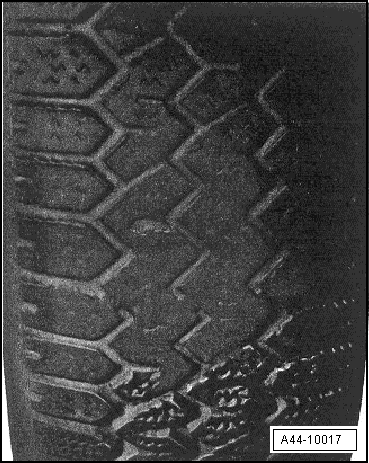
Volkswagen Polo Service & Repair Manual: Wear Spots
| Wear spots are caused by a hard stop with locked wheels
whereby the rubber compound is abraded from the contact patch. |
| When the tires slide across the road surface, frictional
heat is generated which reduces the abrasion resistance on the
tread compound. |
| Even the most abrasion-resistant tread compound cannot
prevent wear spots which can occur during extreme braking. |
| Even ABS cannot completely prevent brief locking and the
resulting slightly flat spots. |
| The degree of abrasion is primarily dependent on the vehicle
speed, road surface and tire load. For clarification see the
following examples. |
| If a vehicle with locked front wheels is decelerated until
it comes to a stop, the abrasion of rubber on the post card
sized contact patch is approximately |
| from 57 km/h (35.41 mph) = 23.8 m braking distance, up to
2.0 mm, |
| from 75 km/h (46.60 mph) = 41.8 m braking distance, up to
3.3 mm, |
| from 92 km/h (57.16 mph) = 71.6 m braking distance, up to
4.8 mm. |
|
|
|
| Tires with this type of damage cannot be used and must be
replaced. |
|
|
|
Rolling noise perceived by the human ear is caused by
vibrations transmitted from the noise source to the ear via the
air.
Here we are interest ...
Other materials:
Washing the vehicle with a high-pressure cleaner
First read and observe the introductory information
and safety warningsFollow the instructions provided by the manufacturer when
cleaning your vehicle using a high-pressure cleaner. This applies in particular
to the pressure and the spraying distance .
Maintain sufficient distance to soft m ...
Dimensions
Fig. 17 Dimensions
First read and observe the introductory information
and safety warnings
The data in the table apply to the most basic German model.
The specified values can vary due to different tyre and wheel sizes, if additional
equipment is fitted, for different model versions, for ret ...
Bag hook
Fig. 89 In the luggage compartment: bag
hook
First read and observe the introductory information
and safety warnings
Bag hooks can be found to the left and right in the luggage compartment. Light
shopping bags can be secured here .
WARNING
Never use the bag hooks as fastening rings for s ...
© 2016-2026 Copyright www.vwpolo.net


 Tires, Rolling Noises, General Information