Volkswagen Polo Service & Repair Manual: Checking with Expansion Valve and Receiver/Dryer, with Internally Regulated
A/C Compressor
 Note Note
| Connecting service station. Refer to
→ Chapter „Connecting Service Station“. |
| Observe test requirements. Refer to
→ Chapter „Pressures, Checking“. |
| – |
Bring engine speed up to 2000 RPM. |
| – |
Observe manometer battery. |
Note
| Switching pressures and design of refrigerant circuit
switches are vehicle-specific. |
| The pressures should be measured at the service connections.
The location of these connections is vehicle-specific. |
| Increasing from initial pressure (when connecting the
pressure gauges) to a maximum of 20 bar (290 psi). |
|
|
|
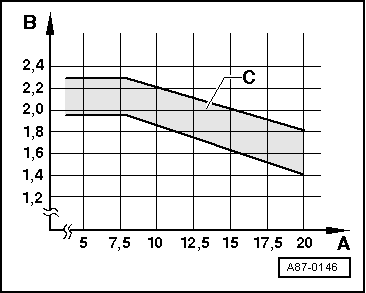
| Decreasing from initial pressure (when connecting pressure
gauges) to the value in the graph. |
| A - |
High pressure in bar (psi) |
| B - |
Low pressure in bar (psi) |
| C - |
Permissible tolerance range |
|
|
|
|
Possible deviation from specification |
Possible cause of fault |
Corrective
action |
| High pressure remains constant or increases only slightly
(above pressure with engine stopped), |
| Low pressure quickly drops to value in graph or below |
| Required cooling output is not attained |
|
Not enough refrigerant in
circuit or expansion valve malfunctioning. |
| – |
Extract refrigerant from the refrigerant circuit |
| If quantity of refrigerant extracted roughly corresponds to
specified capacity: |
| – |
Replace expansion valve |
| – |
Charge the refrigerant circuit. |
|
| Low pressure in line with value in graph |
| Required cooling output is not attained |
|
|
| If quantity of refrigerant extracted is substantially less
than specified capacity: |
| – |
Localize the leak with leak detector and eliminate |
| – |
Charge the refrigerant circuit. |
|
Note
| If no malfunction can be found and the function of the A/C
system is not correct after repeating the test, flush (clean)
refrigerant circuit with refrigerant R134a. Refer to
→ Chapter „Refrigerant Circuit, Flushing (Cleaning) with
Refrigerant R134a“. If that is not possible in this
workshop, flush the refrigerant circuit with compressed air and
remove moisture with nitrogen. Refer to
→ Chapter „Refrigerant Circuit, Flushing with Compressed Air and
Nitrogen“. |
|
|
|
|
Possible deviation from specification |
Possible cause of fault |
Corrective
action |
| High pressure increases above specification |
| Low pressure quickly drops to value in graph or below |
| Required cooling output is not attained |
|
| Constriction or obstruction in refrigerant circuit |
|
| – |
Run hand over refrigerant circuit to check for differences
in temperature |
| If difference in temperature is found at one component: |
| – |
Replace the hose or pipe if kinked or constricted. |
| – |
If there is an obstruction, flush refrigerant circuit with
compressed air and nitrogen and replace expansion valve. |
| If no malfunction can be found. |
| – |
Flush (clean) refrigerant circuit. Refer to
→ Chapter „Refrigerant Circuit, Flushing (Cleaning) with
Refrigerant R134a“. |
|
Note
| If the function is not correct after flushing the
refrigerant circuit, the expansion valve must be replaced. |
|
|
|
|
Possible deviation from specification |
Possible cause of fault |
Corrective
action |
| High and low pressure normal at first |
| After some time, high pressure increases above specification
and low pressure drops to value in graph or below |
| Required cooling output is no longer attained. |
|
| Moisture in refrigerant circuit |
|
| – |
Examine expansion valve for dirt or corrosion; replace if
necessary. |
| – |
Flush refrigerant circuit with compressed air and nitrogen. |
| – |
Replace receiver/dryer. |
| – |
Repeat test if function is not OK. |
| – |
Flush (clean) refrigerant circuit. Refer to
→ Chapter „Refrigerant Circuit, Flushing (Cleaning) with
Refrigerant R134a“. |
| – |
Charge the refrigerant circuit. |
|
Note
| Always replace receiver/dryer in case of this malfunction. |
|
Possible deviation from specification |
Possible cause of fault |
Corrective
action |
| High pressure normal or too high (see diagram), |
| Required cooling output is not attained |
| A/C compressor noise (particularly after switch-on) |
|
| Too much refrigerant in the circuit. |
| Expansion valve or A/C compressor faulty. |
|
| – |
Extract refrigerant from the refrigerant circuit |
| If quantity of refrigerant extracted roughly corresponds to
specified capacity: |
| – |
Replace expansion valve |
| – |
Charge the refrigerant circuit. |
| If quantity of refrigerant extracted is substantially
greater than specified capacity: |
| – |
Charge the refrigerant circuit. |
|
Note
| If the function of the A/C system is not correct when the test is
repeated, re-install old expansion valve and flush refrigerant circuit
with compressed air and nitrogen. Then replace A/C compressor and
receiver/dryer. |
|
Possible deviation from specification |
Possible cause of fault |
Corrective
action |
| High pressure only increases slightly above pressure with
engine stopped |
| Low pressure drops only slightly |
| Required cooling output is not attained |
|
|
| – |
Flush (clean) refrigerant circuit. Refer to
→ Chapter „Refrigerant Circuit, Flushing (Cleaning) with
Refrigerant R134a“. |
| – |
Replace A/C compressor and receiver/dryer. |
|
|
Possible deviation from specification |
Possible cause of fault |
Corrective
action |
| Low pressure too low (see graph) |
| The required cooling performance is obtained |
|
| Expansion valve or A/C compressor faulty |
|
| – |
Replace expansion valve |
| – |
Charge the refrigerant circuit. |
|
Note
| If A/C system function is not OK when the test is repeated,
flush (clean) refrigerant circuit. Refer to
→ Chapter „Refrigerant Circuit, Flushing (Cleaning) with
Refrigerant R134a“. Then replace A/C compressor and
receiver/dryer. |
| With this malfunction, evaporator may ice up although
quantity of refrigerant in circuit is OK. |
|
|
|
|
Possible deviation from specification |
Possible cause of fault |
Corrective
action |
| High and low pressure normal |
| Required cooling output is not attained |
|
To much refrigerant oil in the
circuit. |
| – |
Discharge the refrigerant circuit. |
| – |
Flush (clean) refrigerant circuit. Refer to
→ Chapter „Refrigerant Circuit, Flushing (Cleaning) with
Refrigerant R134a“. |
|
| High and low pressure normal |
| A/C compressor noise (particularly after switch-on) |
| The required cooling performance is obtained |
|
|
|
Note
| Overfilling with refrigerant oil can occur in the event, for
example, the compressor has been replaced without adjusting the quantity
of refrigerant oil. |
| If the A/C compressor is not replaced, the refrigerant oil should be
drained from the A/C compressor via the oil drain plug. Out of the
entire quantity of refrigerant oil, 50 grams should be put in the A/C
compressor and the rest in the refrigerant circuit. Refer to
vehicle-specific repair manual. |
Note
Connecting service station. Refer to
→ Chapter „Connecting Service Station“.
Observe test requirements ...
Other materials:
Tires, Mounting, Wheels without and with Tire Pressure Monitoring System
Only trained personnel can perform the assembly work on
run-flat tires.
If equipped check the tire pressure monitoring sensor with
the vehicle diagnostic tester and if necessary replace.
–
Bring the t ...
Paint Thickness Tester -VAS6272
Definition:
Paint Thickness Tester -VAS6272-
Product Description
The paint layer thickness measuring instrument -VAS6272
Paint Thickness Tester- is a combination measuring instrument
used for ...
Professional Cleaning Cloth -VAS6006
Definition:
Professional Cleaning Cloth -VAS6006-
Product Description:
The cloth is suitable for dry cleaning surfaces (dust and
microdust). I has anti-static properties when used to clean
pl ...
© 2016-2026 Copyright www.vwpolo.net


 Checking with Restrictor and Reservoir, with Internally Regulated A/C
Compressor
Checking with Restrictor and Reservoir, with Internally Regulated A/C
Compressor