
Volkswagen Polo Owners Manual: Vehicle identification data
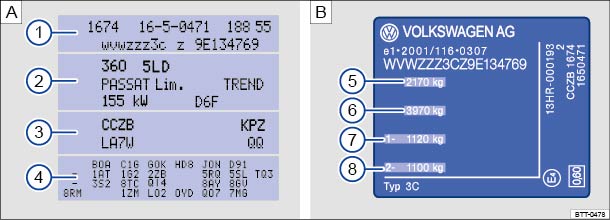
Fig. 15 A: Vehicle data sticker: example shows a vehicle with engine code CCZB ③. B: Type plate
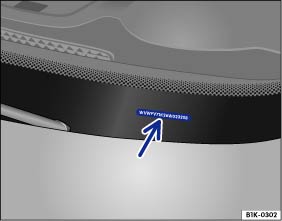
Fig. 16 Vehicle identification number
 First read and observe the introductory information
and safety warnings
First read and observe the introductory information
and safety warnings
Vehicle identification number (FIN)
The vehicle identification number can be read from outside the vehicle through
a viewer in the windscreen (arrow). The viewer is located in the lower corner of
the windscreen. The vehicle identification number is also stamped on the right water
drain channel. The water drainage channel is located between the suspension turret
and wing. You have to open the bonnet
 to gain access to the vehicle identification
number .
to gain access to the vehicle identification
number .
Vehicle data sticker
The vehicle data sticker A is in the spare wheel well area in the luggage compartment. It contains the following data:
 Vehicle identification number (chassis
number)
Vehicle identification number (chassis
number)  Vehicle type, engine power, gearbox type
 Engine and gearbox code, paint number,
interior equipment. In the example, the engine code is CCZB .
Engine and gearbox code, paint number,
interior equipment. In the example, the engine code is CCZB .  Optional extras, PR numbers
These vehicle data are also contained in the service schedule.
Type plate
The type plate B can be seen on the lower part of the door pillar when the door is open. Vehicles for certain export countries do not have a type plate.
The type plate contains the following data:
 Gross vehicle weight rating
  Gross combination weight (vehicle plus
trailer)
Gross combination weight (vehicle plus
trailer)  Gross axle weight rating, front
  Gross axle weight rating, rear
 Introduction
This chapter contains information on the following subjects:
→ Vehicle identification data
→ Engine data
→ Dimensions
→ Performance figures
The vehicle data stic ...
 Engine data
First read and observe the introductory information
and safety warnings
For reasons of vehicle registration and vehicle taxation, the power output and
performance of some engines may vary in some ...
Other materials:
Water Content
Only very small amounts of water are soluble in liquid
refrigerant. On the other hand, refrigerant vapor and water
vapor mix in any ratio.
Only a small drop of water may get into the refrigerant
circuit. The dryer, dryer bag or dryer car ...
EU Tire Label, Categories
Rolling Resistance. Refer to
→ Anchor
Wet Grip. Refer to
→ Anchor
Noise Emission. Refer to
→ Anchor
Rolling Resistance ...
The dangers of assuming an incorrect sitting position
First read and observe the introductory information
and safety warnings
If the seat belts are not worn or are worn incorrectly, the risk of severe or
fatal injuries increases. Seat belts can only provide optimal protection if the
seat belt routing is correct. Assuming an incorrect sitting pos ...
