Volkswagen Polo Service & Repair Manual: Pressure Relief Valve
 Caution
| Non-approved tools or materials such as leak sealing
additives can cause damage or malfunctions in the
system. |
| Only use tools and materials approved by the
manufacturer. |
| The warranty is voided if non-approved tools or
materials are used. |
|
| All components of the refrigerant circuit submitted for
quality observation are always to be sealed (use original
sealing caps of original part). |
| Replace damaged or leaking components of refrigerant
circuit. Refer to
→ Chapter „Components, Replacing“. |
| To date, the original parts (compressor, reservoir,
receiver/dryer, evaporator and condenser) have been filled with
nitrogen gas. This charge is being gradually discontinued. There
is little or no pressure equalization when removing the sealing
plugs from the original part. |
|
|
|
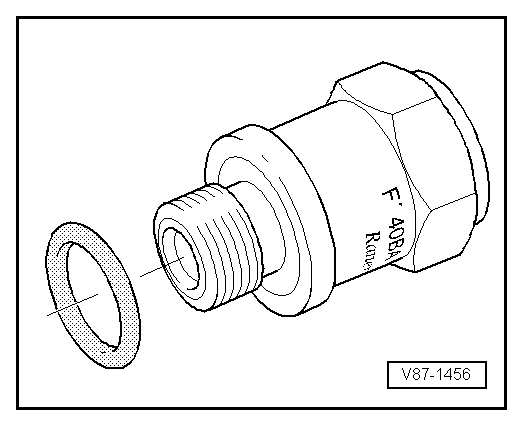
| The pressure relief valve is installed on the A/C compressor
or receiver/dryer. |
| At a pressure of approximately 38 bar (551 psi) positive
pressure, valve opens and closes again once pressure has
dissipated (approximately 30 bar (435 psi)). |
| Refrigerant does not escape completely. |
| Depending on the version, a transparent plastic disc may be
installed which breaks off as soon as the valve is activated. |
|
|
|
Caution
Non-approved tools or materials such as leak sealing
additives can cause damage or malfunctions in the
sys ...
Other materials:
Maximum permitted gross combination weight
First read and observe the introductory information
and safety warnings
All data in the official vehicle documents take precedence over these data. All
data in this manual apply to the basic model. The vehicle data sticker in the service
schedule and the official vehicle documents show which ...
Adjusting the steering wheel position
Fig. 41 Adjusting the steering wheel position
mechanically
First read and observe the introductory information
and safety warnings
Adjust the steering wheel position before setting off and only when the vehicle
is stationary.
Push down the lever .
Adjust the steering wheel so th ...
Checking the coolant level and refilling coolant
Fig. 139 In the engine compartment: mark
on the coolant expansion tank
Fig. 140 In the engine compartment: coolant
expansion tank cap
First read and observe the introductory information
and safety warningsThe warning lamp for the engine coolant will light up
if the engine coolant level i ...
© 2016-2026 Copyright www.vwpolo.net


 Refrigerant Circuit Pipes and Hoses