Volkswagen Polo Service & Repair Manual: Physical Principles
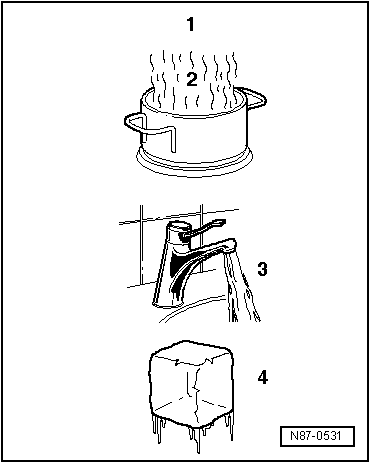
| The four known states of water also apply to air
conditioning system refrigerants. |
|
|
|
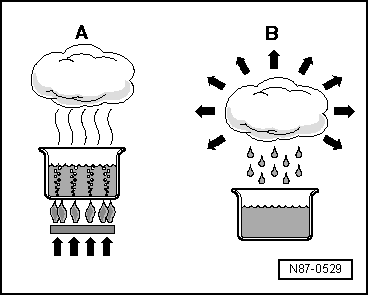
| When water is heated in a vessel (heat absorption), water
vapor can be seen to rise. If the vapor is further heated
through heat absorption, the visible vapor turns into invisible
gas. The process is reversible. The warmth is extracted from
gaseous water, vapor forms first, then water and then ice. |
|
|
|
Heat Transfer
| Every substance consists of a mass of moving molecules. The
fast moving molecules of a warmer substance give off some of
their energy to the cooler and thus slower molecules. As a
result, the molecular motion of the warmer substance slows down
and that of the colder substance is accelerated. This process
continues until the molecules of both substances are moving at
the same speed. They are then at the same temperature and no
further heat exchange takes place. |
|
|
|
The boiling point given in tables for a liquid is always
referenced to an atmospheric pressure of 1 bar (14.5 psi). If
the pressure acting on a fluid changes, its boi ...
Other materials:
Two-Part HS Hardener
Definition:
Two-Part HS Hardener -LHA 009 041 A3-
Two-Part HS Hardener, Short -LHA 021 004 A3-
Two-Part HS Hardener, Extra Short -LHA 009 046 A2-
Two-Part HS Hard ...
Introduction
This chapter contains information on the following subjects:
→ Locking or unlocking the driver door manually
→ Locking the front passenger door and rear doors manually
→ Unlocking the tailgate manually
→ Unlocking the selector lever lock manually
If the vehic ...
Refrigerant R134a Environmental Information
Vehicle air conditioning systems make use of the
vaporization and condensation process. In this case, one works
with a substance which boils easily, designated as refrigerant.
The refrigerant employed is tetrafluoroethane R134a, which
bo ...
© 2016-2026 Copyright www.vwpolo.net



 Pressure and Boiling Point