Volkswagen Polo Service & Repair Manual: Wheel, Balancing, Tire and Wheel Radial and Lateral Run-Out, Checking
| Before beginning balancing, the following requirements must
be fulfilled. |
| The tire pressure must be OK. |
| The tire profile must not be worn on one side. The tire
profile must be at least 4 mm. |
| The tires must not have any damage such as cuts, holes,
foreign bodies, etc. |
| The suspension and steering, including the shock absorber,
must be in perfect condition. |
| Test drive performed. Refer to
→ Chapter „Vibration, Road Test, Performing Before Balancing“. |
| Radial and lateral run-out occur when the wheel and tire are
not running precisely true. |
| For technical reasons, 100% true running is not possible. |
| Therefore the manufacturers of these components allow a
precisely specified tolerance. |
| Mounting the tire in a unfavorable position on the wheel can
be the cause for exceeding the maximum allowed tolerance for
wheel with tire. |
| – |
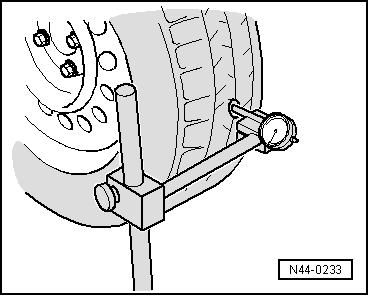
Preload the Tire Dial Gauge approximately 2 mm. |
|
|
|
| – |
Position the Tire Dial Gauge on the side wall of the tire. |
| – |
Rotate the wheel slowly. |
| – |
Note the smallest and the largest dial readings. |
 Note Note
| If the difference is greater than 1.3 mm, the lateral
run-out is too great. |
| In this case the radial run-out can be reduced by matched
mounting. Refer to
→ Chapter „Tires and Rims, Matching“. |
| Peak values on the Tire Dial Gauge due to small
irregularities in the rubber may be disregarded. |
| – |
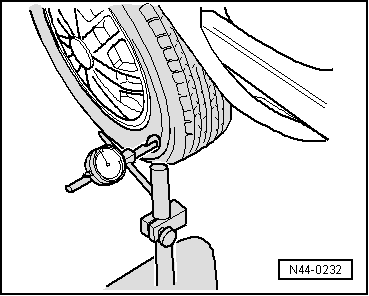
Preload the Tire Dial Gauge approximately 2 mm. |
|
|
|
| – |
Position the Tire Dial Gauge on the tread of the tire. |
| – |
Rotate the wheel slowly. |
| – |
Note the smallest and the largest dial readings. |
Note
| If the difference is greater than 1 mm, the radial run-out
is too great. |
| In this case the radial run-out can be reduced by matched
mounting. Refer to
→ Chapter „Tires and Rims, Matching“. |
| The table shows the maximum permissible tolerance values for
the wheel with mounted tire. |
| Tolerances for Radial and Lateral
Run-Out of Rim With Tire |
|
|
|
|
Rim With Tire |
Radial
Run-Out (mm) |
Lateral
Run-Out (mm) |
|
Passenger Vehicle |
0.9 |
1.1
(1.3 near the lettering) |
Before beginning balancing, the following requirements must
be fulfilled.
The tire pressure must be OK.
The tire p ...
Mount the rim on the Balancing Machine.
–
Use the Wheel Centering System Adapter -VAS5271-.
–
Preload th ...
Other materials:
Warning lamp
First read and observe the introductory information
and safety warnings
Lit up
Possible cause
Solution
Fault in the alternator.
Go to a qualified workshop. The electrical system should
be checked.
Switch off all electrical ...
Combined curtain and side airbags
Fig. 60 On left-hand side of vehicle:
deployment zone of the combined curtain and side airbags (variant A). On the side
of the front seat: location and deployment zone of the combined curtain and side
airbag (variant B)
First read and observe the introductory information
and safety warning ...
Tyre Pressure Loss Indicator
Fig. 124 In the stowage compartment on
the front passenger side: button for the Tyre Pressure Loss Indicator
First read and observe the introductory information
and safety warnings The Tyre Pressure Loss Indicator uses data
from the ABS sensors and other functions to check the speed of rot ...
© 2016-2026 Copyright www.vwpolo.net


 Wheel, Balancing with Fine Balancing Machine (Finish Balancer)
 Wheel Balancing, Rim Radial and Lateral Run-Out, Checking