Volkswagen Polo Service & Repair Manual: A/C System, Operating after Charging
 Caution
| If it is suspected that chemicals were added to the
refrigerant circuit to seal leaks, do not connect the
A/C service station and do not extract the refrigerant. |
| Chemicals that seal leaks in the coolant circuit
form deposits that affect the function of the A/C system
and lead to failure of the A/C system and the A/C
service station. |
| Inform that customer that there are substances in
the A/C system that are no approved by Volkswagen. This
A/C system cannot be drained or serviced in the
workshop. |
|
 Note Note
| The chemical materials (stop leak additive) for sealing
leaks in the refrigerant circuit offered on the market are not
approved by VW Audi AG. There are no permanent- ,validity or
material compatibility tests. Therefore damage or malfunctions
in the A/C system or the A/C Service Station cannot be excluded. |
| The stop leak additives offered on the open market have
different physical and chemical properties, which can impair the
function of the A/C system and the A/C Service Station and can
even shut down the system completely. |
| VW does not approve the use of chemicals to seal leaks in
the refrigerant circuit. |
| Chemicals used to seal leaks in the refrigerant circuit
often react with air and the moisture in it. They cause deposits
in the refrigerant circuit and the A/C service station and
malfunctions in valves and other components that they come in
contact with. These deposits cannot be removed completely from
the components. |
| Chemicals used to seal leaks in the refrigerant circuit
usually cannot be detected from outside. The label that should
be applied to identify it is often missing. Therefore be careful
when working with if you do not know its service history. |
| Accessories offer containers used to separate out these
chemicals (used to seal leaks in the refrigerant circuit).
Because VW does not approve the use of these chemicals, there is
no evidence of the effectiveness of these filters. |
Note
| If A/C compressor was removed, it must be cranked by hand at
ribbed belt pulley/freewheel approximately 10 rotations before
bringing into operation for the first time. This prevents damage
in the A/C compressor due to liquid when switching the A/C
system on. If there is oil in the A/C compressor cylinder, it
will be forced out. |
|
|
|
| – |
Start engine with compressor switched off (version with A/C
clutch). |
| – |
Set the A/C compressor to minimum output, for example,
"ECON" mode or A/C off (version with no A/C clutch with
regulator valve). |
| – |
Wait until idle speed has stabilized. |
| – |
Switch on the compressor and operate the system for at least
two minutes at idling speed. |
| – |
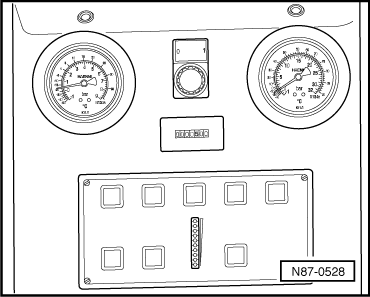
If necessary, check pressures in refrigerant circuit using
A/C service station. |
| – |
Screw out handwheel on quick-release coupling adapter. |
| – |
Disconnect charging hose from refrigerant circuit. |
| – |
Screw protective caps back on. |
|
|
|
Caution
If it is suspected that chemicals were added to the
refrigerant circuit to seal leaks, do not connect the ...
Caution
If it is suspected that chemicals were added to the
refrigerant circuit to seal leaks, do not connect the ...
Other materials:
Tires, Damage from Low Tire Pressure
The most common causes of failure are small external damage,
a defective valve or a leaky rim due to corrosion or damage.
Separation of Carcass and Rubber
Strong heating due to driving w ...
One-Part Clean Spray Can -LLS MAX 112-, Aqua Premium System
One-Part Clean Spray Can -LLS MAX 112-, 400 ml for
Water-Based Mixed Paint “Aqua Premium System”
Edition 05/2014
Product Description
These products include a paint spray nozzle prefilled with a
...
Locking or unlocking the driver door manually
Fig. 155 Door handle on driver
door with lock cylinder
First read and observe the introductory
information and safety warnings
If locked manually, all doors are locked. If unlocked manually, only the
driver door is unlocked. Observe information on the anti-theft alarm .
Fold the key bi ...
© 2016-2026 Copyright www.vwpolo.net


 Refrigerant Circuit with A/C Service Station, Filling
 Refrigerant in A/C Service station Container, Filling