
Volkswagen Polo Owners Manual: Refuelling autogas
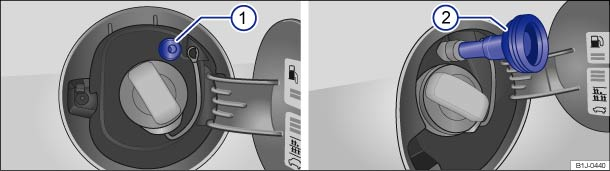
Fig. 132 In the right-hand side of the vehicle at the rear: open tank flap with tank cap for gas filler neck ① and adapter ②
 First read and observe the introductory information
and safety warnings
First read and observe the introductory information
and safety warnings Switch off the engine, ignition and mobile telephone before refuelling .
Please read and follow the instructions for the autogas refuelling system.
Opening the tank cap
The autogas filler neck is located behind the tank flap next to the petrol filler neck.
- Unlock the vehicle using the vehicle key or the
 button in the driver door
.
button in the driver door
.
- The tank flap is at the rear of the vehicle on the right.
- Press on the tank flap in the direction of the arrow . The tank flap will spring open slightly.
- Open the tank flap fully.
Filling the tank
- Unscrew the cap anticlockwise to remove it from the gas filler neck .
- Screw the appropriate adapter ② clockwise onto the gas filler neck.
- Refuel as described in the filling station instructions.
- The fuel tank is full when the compressor for the refuelling system switches off automatically.
- To prematurely stop the tank filling process, release the refuelling system button.
Closing the tank cap
- Unscrew the adapter anticlockwise to remove it from the gas filler neck . Stow it in a safe place.
- Screw the cap clockwise onto the gas filler neck ①.
- Close the tank flap so that it engages audibly. The tank flap must be flush with the vehicle bodywork.

 WARNING
- Autogas is highly explosive and inflammable.
- A small amount of autogas can leak after the filling procedure has been completed. There is a risk of frostbite if it comes into contact with skin.

One country-specific adapter is supplied with your vehicle. We recommend that you purchase all of the adapters and carry them in the vehicle at all times as different countries have different filling stations.
At very high ambient temperatures, the overheating protection function for the autogas refuelling system can switch off automatically.
At very high ambient temperatures, the pressure in the vehicle's autogas tank can be the same as or higher than the pressure in the gas tank of the autogas refuelling system. For physical reasons, it is not then possible to refuel the vehicle.
The fill couplings for autogas refuelling systems have a variety of methods of operation. Please ask for assistance from trained filling station personnel if you are unsure of how to use the system.
Noises that occur during refuelling are normal and do not indicate system damage.
 Filling the tank with petrol or diesel
Fig. 130 In the right-hand side of the
vehicle at the rear: tank flap open
Fig. 131 Open tank flap with tank cap attached
to the holder
First read and observe the introductory information
an ...
 Capacities
First read and observe the introductory information
and safety warnings
Fuel tank capacity
Petrol and diesel engines
approx 45.0 l,
...
Other materials:
Winter tires
M+S-Symbol
On “M-and-S-tires”, the tread pattern, tread compound or
type are designed such that the handling characteristics in snow
are improved compared to a normal tire. This is especially true
when initiating or maintaining vehic ...
Maximum permitted gross combination weight
First read and observe the introductory information
and safety warnings
All data in the official vehicle documents take precedence over these data. All
data in this manual apply to the basic model. The vehicle data sticker in the service
schedule and the official vehicle documents show which ...
Protecting
Caution
Missing protection leads to the electrical system
damage.
Note
All threaded connections must be tightened to the specified
torque.
...
