Volkswagen Polo Service & Repair Manual: Battery Charger -VAS5095A- Device Description
 WARNING
| Risk of injury. Follow all Warnings and Safety
Precautions. Refer to
→ Chapter „Warnings and Safety Precautions“. |
|
 Caution
| In order to prevent damage to the battery or
vehicle, observe battery type descriptions and notes.
Refer to
→ Chapter „Types of Batteries“. |
|
WARNING
| Batteries that have a light yellow visual indicator
do not have to be tested or charged. Jump starting must
not be used! |
| There is a risk of explosion during testing,
charging or jump starting. |
| These batteries must be replaced. |
|
| In this chapter, the base functions of the Battery Charger
-VAS5095A- are described. Refer to Battery Charger -VAS5095A-
Operating Instructions for additional information. |
 Note Note
| The effective charging current cannot be read out on this
unit. The charging current must be measured externally with a
current probe. |
| Pay attention to the Battery Charger -VAS5095A- Operating
Instructions. |
| The Battery Charger -VAS5095A- is designed to charge all 12
V batteries in the VW group. |
| The battery is charged without amperage or voltage surges.
Thereby the on-board electronics will not be affected. It is not
necessary to remove the battery from the vehicle or be
disconnected from the electrical system during charging. |
|
|
|
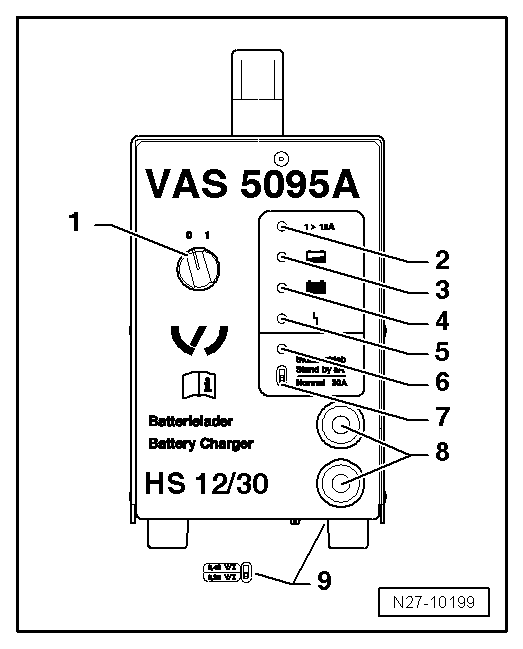
| Battery Charger -VAS5095A- |
| 1 - |
Switch ON/OFF (0 = Charger OFF) |
| 2 - |
Charge current display (I > 12 A) |
| 3 - |
Charge current display: battery partially charged > 90% |
| 4 - |
Charger sustain, lights up green when battery is charged |
| 5 - |
Interference indicator |
| 6 - |
Support mode indicator |
| 7 - |
Support mode/normal mode selector switch |
| 8 - |
Charger cables, red charging clamp “+”, black charging clamp
“-”. |
| 9 - |
Battery type selector switch (base of loading devices) |
|
|
 |
Special tools and workshop equipment
required
Battery Charger -VAS5095A-
WARNING
...
Other materials:
Maximum permitted trailer weights
First read and observe the introductory information
and safety warnings
All data in the official vehicle documents take precedence over these data. All
data in this manual apply to the basic model. The vehicle data sticker in the service
schedule and the official vehicle documents show which ...
Spare wheel or temporary spare wheel
Fig. 148 In luggage compartment: variant
A: handwheel for securing spare wheel and variant B: handwheel for securing temporary
spare wheel
First read and observe the introductory information
and safety warningsRemoving the spare wheel
Open the tailgate then lift up and secure the variab ...
Cleaning and changing windscreen wiper blades
Fig. 142 Variants A and B: Changing the
windscreen wiper blades. Variants B and C: Changing the rear window wiper blade
First read and observe the introductory information
and safety warningsThe factory-fitted windscreen/window wiper blades are
coated with graphite. The graphite coating ens ...
© 2016-2026 Copyright www.vwpolo.net



 Battery, Charging with Battery Charger -VAS5095A